


This Week’s Smart Girl Syllabus for Better Thinking
Jul 5
4 min read

THIS WEEK’S SMART GIRL SYLLABUS
What to consume, absorb, and quietly level up from
There is a quiet shift happening in the way people are starting to think about content. Not all of it is dramatic or even intentional, but there is a growing awareness that what you repeatedly consume does not just pass time, it builds cognition. It shapes attention spans, influences how you process information, and slowly trains the brain to either expand or contract. The difference between being constantly entertained and being mentally stimulated is becoming harder to ignore, especially in a world where everything is designed to keep you scrolling rather than thinking.
A lot of modern content is built for frictionless consumption. It asks very little of you. It is fast, visual, emotionally immediate, and often forgettable. There is nothing inherently wrong with that, but when it becomes the dominant diet, it quietly changes how your brain engages with complexity. Thinking becomes slower. Focus becomes fragmented. Even curiosity starts to feel shorter in duration.
On the other side of that sits a different kind of intake. Content that does not just fill space but builds internal structure. Books, long-form writing, podcasts that require attention rather than background listening, and ideas that linger long after the screen is off. This is not about being overly intellectual. It is about maintaining a level of mental activity that keeps your thinking flexible, curious, and capable of depth.
This syllabus is less about productivity and more about mental nutrition. What you consume becomes what you are able to articulate, question, and understand over time. The goal is not to optimise every moment, but to avoid passively dulling the very thing that makes you interpret the world.
LISTEN: Working Hard by Grace Beverly
There is a noticeable difference between content that glamorises productivity and content that actually helps you understand it. This falls into the second category. It is structured, calm, and focused on systems rather than intensity.
The core idea is not to do more, but to do with more clarity. It explores how discipline is built without burnout and how structure can exist without rigidity. For anyone navigating work, ambition, or personal goals, it becomes less about motivation and more about repeatable frameworks. It is the kind of listening that does not just inspire action, but reorganises how action is approached.
READ: Substack Newsletter – Financial Hot Girl by Devamsha Gunputh
Short-form writing often gets underestimated, but this is where precision matters more than length. These essays are concise but not shallow. They take complex financial and cultural ideas and translate them into something immediately understandable without stripping away nuance.
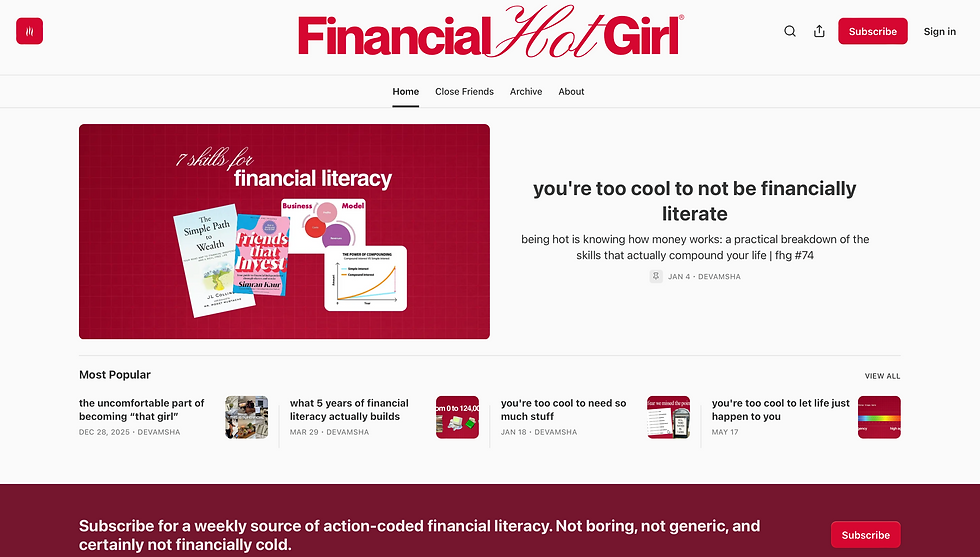
What stands out is clarity. There is no unnecessary layering, no intimidation, and no assumption that financial literacy has to feel inaccessible. It makes money conversations feel less like a separate category and more like part of everyday decision-making. It is especially useful in a content environment where financial advice is often either too technical or too aesthetic to be useful.
READ + PRACTICE: Roxie Nafousi – Manifest and structured mindset work
There is a tendency to dismiss manifestation content as abstract, but when stripped of aesthetic framing, it becomes something closer to cognitive repetition training. The focus here is not on wishing, but on shaping thought patterns through consistency.
The emphasis is on clarity, emotional regulation, and behavioral alignment. What you repeatedly tell yourself and reinforce through action eventually becomes the default way you interpret situations. It is less about attracting outcomes and more about training response patterns.

The value comes from repetition rather than intensity. It is a slow recalibration of internal narrative rather than a dramatic shift.
READ: Rich Girl Nation by Katie Gatti Tassin
This book sits in a space that is less about finance as a subject and more about financial awareness as identity. It unpacks how money is not just earned or spent, but mentally structured. The way people think about independence, safety, and choice is often shaped long before they ever earn consistently.

What makes it important is the shift it creates in perspective. It moves financial thinking away from survival mode or aspiration mode and into something more intentional. It forces a confrontation with habits that feel normal but are rarely questioned. The result is not just better financial literacy, but a clearer understanding of how autonomy is built over time.
LISTEN + READ: Aspire with Emma Grede + Start With Yourself
This combination sits at the intersection of self-development and real-world execution. Emma Grede’s conversations in particular remove a lot of the romanticisation around building anything at scale. They are grounded in decisions, responsibility, and consistency rather than motivation.
What becomes clear through this kind of content is that success is rarely abstract. It is the accumulation of decisions that often feel small in the moment but compound significantly over time. There is a strong emphasis on ownership, not just of outcomes but of process.
Paired with reflective content like Start With Yourself, it reinforces a simple but often overlooked idea. Most external change begins with internal structure. Not emotion, but behaviour.
The reason this kind of curated input matters is because the brain is not passive. It adapts to what it is repeatedly exposed to. When most consumption is designed to be immediate and low effort, thinking itself starts to follow the same pattern. Shorter attention, quicker reactions, lower tolerance for complexity.
Intentional content interrupts that cycle. It introduces friction in a productive way. It asks the brain to hold ideas longer, connect concepts, and sit with information rather than immediately moving on from it.
This is not about rejecting entertainment or replacing it entirely. It is about balance. A mental environment that includes both stimulation and substance, both ease and depth.
Over time, what you consume becomes how you think. Not in an abstract way, but in how you interpret situations, make decisions, and process uncertainty. That is why the quality of input matters more than the quantity.
Not everything consumed is meant to entertain. Some of it exists to stretch attention, sharpen thinking, and quietly recalibrate how the mind engages with the world.
Love,
Rae


.jpg)


Comments